
Defining “Impairment”
An Investigative Audit of Section 24220 and the Path Toward Mandated In-Vehicle Surveillance

Section 24220 of the Infrastructure Investment and Jobs Act of 2021 created one of the most consequential federal vehicle-surveillance mandates in recent memory: a requirement that the National Highway Traffic Safety Administration (NHTSA) develop a safety standard for advanced impaired-driving prevention technology in all new passenger motor vehicles. Framed as a life-saving anti-drunk-driving measure, the provision is also a legal and technological gateway to passive, always-on monitoring of drivers inside privately owned vehicles. The central audit question is not whether impaired driving is a serious public danger; it is whether Congress wrote a sufficiently bounded law, whether regulators can implement it without creating a broader in-car surveillance architecture, and whether the term “impairment” will become elastic enough to justify detection systems aimed at marijuana, prescription drugs, fatigue, distraction, or generalized “fitness to drive.”
Status in 2026
As of February 2026, NHTSA had still not finalized the Federal Motor Vehicle Safety Standard (FMVSS) required by Section 24220. In its 2026 report to Congress, the agency said it had received more than 3,000 unique public comments after the January 2024 advance notice of proposed rulemaking (ANPRM) and that the available technologies were not yet mature enough to satisfy the statute and the Safety Act at scale. NHTSA also said it continues to work on technology readiness, objective test procedures, consumer acceptance, cybersecurity, and privacy concerns, and that it will keep submitting annual reports to Congress until a rule is issued.
The latest report is important because it undercuts the notion that the mandate is already a near-term, plug‑and‑play reality. NHTSA stated that no commercially available technology has yet demonstrated the precision, speed, and reliability needed to passively detect alcohol impairment with the accuracy demanded by the law. The agency also noted that, even at a 99.9 percent accuracy rate, the sheer scale of American driving would still create millions to tens of millions of false positives or false negatives each year. That admission is central to any investigative audit because it reveals the gap between legislative ambition and engineering reality.
There are also continuing political efforts to weaken or roll back the mandate. Reporting in 2025–2026 describes congressional efforts to defund or repeal the provision, including the “No Kill Switches in Cars Act” (H.R. 1137), which would bar federal requirements for technologies that can remotely disable vehicles. House debates and advocacy campaigns characterize Section 24220 as a de facto “kill switch” mandate and warn about false positives, hacking risks, and government or corporate misuse. Whether those efforts succeed or fail, they show that Section 24220 remains contested not just as an engineering question, but as a governance and civil-liberties issue.
Statutory Scope
Section 24220 directs NHTSA to issue an FMVSS requiring advanced impaired-driving prevention technology in new passenger vehicles. The statute contemplates systems that can passively monitor a driver’s performance to identify impairment, passively detect whether a driver has a blood alcohol concentration at or above 0.08, or both, and then prevent or limit vehicle operation when impairment is detected. That language matters because it does not confine the mandate to a single sensor, a single substance, or a single method of proof.
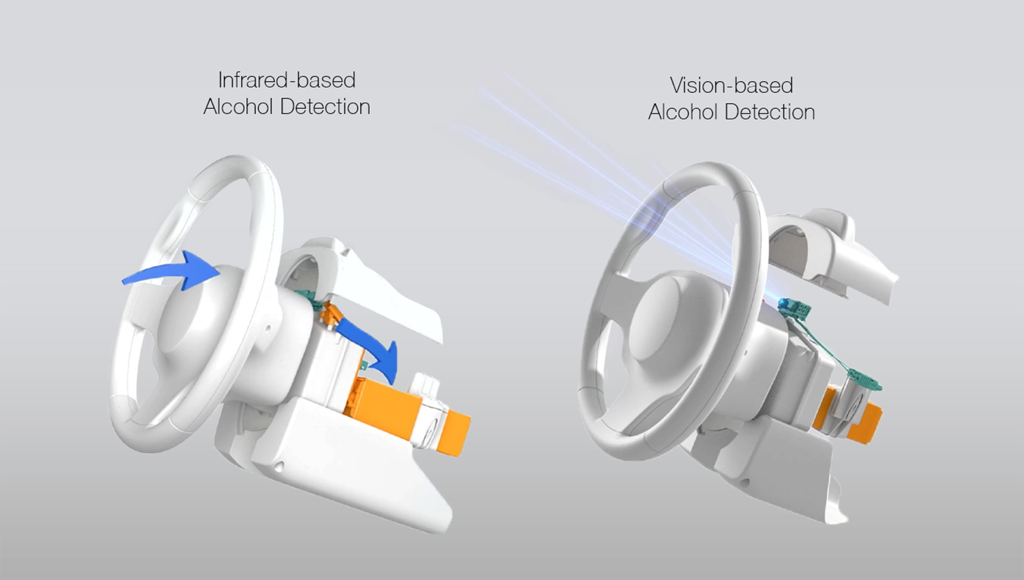
Supporters have consistently described the law as “technology-neutral,” meaning NHTSA can evaluate a range of tools rather than adopt one prescribed device. In practical terms, that means the mandate can be satisfied through breath-based systems, touch-based alcohol sensors, driver‑monitoring cameras, steering or lane-keeping behavior analysis, or combinations of those approaches. What begins as a drunk‑driving countermeasure therefore also creates a regulatory path for integrated surveillance systems that continuously assess behavior, physiology, or cabin conditions before and during operation.
Technology Pathways
NHTSA’s reports and allied advocacy materials show that the federal government and industry have been considering two broad technology families. The first is direct alcohol detection, including touch-based and breath-based systems associated with the Driver Alcohol Detection System for Safety (DADSS) program, a public‑private effort involving NHTSA and the Automotive Coalition for Traffic Safety. The second is indirect or behavioral detection, often bundled into driver‑monitoring systems (DMS) that infer impairment from eye movements, head position, gaze behavior, lane deviations, steering patterns, and related indicators.
This distinction is critical for privacy analysis. A touch sensor embedded in a start button or steering interface is intrusive in one sense, but it is narrower: it asks a limited question about alcohol concentration. A camera‑based or AI‑mediated driver‑monitoring system is broader by design because it watches the driver continuously, generates behavioral inferences, and can be repurposed for multiple objectives beyond alcohol detection, including distraction management, drowsiness, seat‑belt compliance, and occupant monitoring. Privacy researchers have warned that these systems collect personal data, raise concerns about third‑party sharing, and require safeguards such as clear purpose limits, minimization, encryption, and on‑car storage to avoid sliding into generalized surveillance.
Industry examples highlighted by advocates underscore the breadth of the emerging ecosystem. MADD’s fact sheet points to suppliers and automakers including Magna, Hyundai MOBIS, Volvo, Bosch, Nissan, and Toyota as companies exploring combinations of alcohol sensing, facial analysis, and operational behavior detection. Volvo, for example, has described in‑car cameras and other sensors intended to monitor signs of intoxication and distraction, while Smart Eye’s DMS analyzes eye, face, head, and body movements to score driver attention. Once those architectures exist, the practical barrier to adding new detection goals is lower than the political barrier to admitting that expansion is occurring.
Rulemaking and Feasibility
The law set an aggressive timetable, but NHTSA’s own reporting indicates that implementation has not kept pace with the original statutory ambition. The agency’s 2026 report says the technology remains immature, with unresolved issues involving accuracy, reliability, proxy measurements, and the difficulty of validating impairment detection under real‑world conditions. In other words, Congress mandated a capability before the agency had a field‑ready, objective, and widely validated way to deliver it.
That gap matters for two reasons. First, it creates pressure to treat imperfect proxies as acceptable evidence of impairment, especially in behavioral systems that do not directly measure alcohol concentration. Second, it encourages mission creep: if direct alcohol detection is hard to perfect, regulators and manufacturers may rely more heavily on generalized driver‑monitoring systems because those systems can be marketed as multi‑purpose safety platforms while still nominally satisfying the law’s goals.
Privacy and Civil Liberties
The strongest civil‑liberties critique is that Section 24220 normalizes suspicionless monitoring inside a privately owned vehicle as a precondition of lawful operation. The ACLU argued that the mandate raises serious questions because the most plausible implementations involve cameras and biometric analysis that track faces, eyes, and behavior, potentially producing a persistent stream of highly sensitive data. Even if a system is sold as an onboard safety feature rather than a law‑enforcement instrument, the privacy issue does not disappear; data still exists, software still makes inferences, and manufacturers or vendors still face incentives to retain, monetize, share, or repurpose information unless the law clearly forbids it.
Supporters have tried to answer that criticism by asserting that the technology should protect privacy, should not permit data collection for commercial or malicious purposes, and should not allow anyone outside the vehicle to disable it. Those assurances are notable, but they are policy preferences rather than hard statutory limitations in the materials reviewed here. An audit perspective therefore distinguishes between aspirational privacy language and enforceable legal guardrails; the former can be repeated in fact sheets, while the latter must survive procurement, software updates, aftermarket integration, insurance demands, and future rule changes.
False positives compound the privacy problem into a due‑process problem. A system that incorrectly flags a sober driver due to disability, fatigue, atypical eye movements, medical conditions, cabin lighting, or sensor error does not merely observe; it can immobilize or limit the operation of a vehicle that the owner lawfully possesses. The more behavior‑based the system becomes, the harder it is for the public to evaluate the logic behind the determination and the easier it is for manufacturers to shield that logic as proprietary.
False Positives and Equity
NHTSA’s 2026 report concedes that false positives are a major obstacle and that the agency has not yet identified a technology anywhere close to the necessary level of accuracy. That is not just a technical problem; it is an equity problem because any inferential system will disproportionately misread people whose bodies, behaviors, or environments do not conform to an algorithm’s training assumptions. Medical conditions such as neurological disorders, nystagmus, tremor, epilepsy recovery, autism‑related movement patterns, chronic pain, or the effects of prescription medication can all produce signals that look suspicious to a machine but are completely lawful and non‑impairing.
Environmental and situational factors matter as well. Bright glare, poor cabin lighting, passengers speaking to the driver, children in the back seat, unusual seating positions, sunglasses, winter clothing, or rough road conditions can all distort camera‑based or behavior‑based inference. In a rural setting, a false lockout is not a minor inconvenience; it can strand a person far from services, delay medical transport, or make it impossible to complete essential work, school, or caregiving trips. A system that immobilizes a car based on a probabilistic assessment therefore raises a mobility question as much as a safety question.
Data Architecture
The deepest unresolved issue is not merely what the system detects, but what the vehicle does with the resulting data. Modern vehicles already function as data‑rich platforms, collecting telemetry for safety, diagnostics, navigation, infotainment, and remote services, so an impairment system would be entering an ecosystem in which data movement is already normalized. The critical questions are whether impairment‑related data will be air‑gapped, logged only locally, transmitted to the cloud, shared with automakers or vendors, linked to insurance telematics, or updated over the air to add new “impairment” categories over time.
The public record suggests this is not theoretical. The Future of Privacy Forum’s 2024 analysis notes that people are worried about data transfers to third parties and want disclosure limits, encryption, on‑car storage, and de‑identification in driver‑safety systems. That concern aligns with the ACLU’s warning that data collection inside the vehicle should be designed not to become forensic or commercial surveillance. At the same time, telematics‑based insurance, usage‑based pricing, and “safe driving” apps already reward or penalize behavior based on movement data, demonstrating how safety features can become behavioral scoring tools. Once a manufacturer builds the plumbing for in‑cabin sensing, a future software update, vendor partnership, or regulatory revision can widen the use case without requiring a physical redesign of the car.
The Expansion Problem
The phrase “where does this stop?” is not rhetorical excess; it is the core governance issue raised by the statute’s breadth. Congress wrote a law aimed at impaired driving, but “impairment” is not technologically or politically stable. Alcohol has a legal threshold that is imperfect but familiar: 0.08 BAC. Marijuana and many other drugs do not present the same clean regulatory picture, because presence does not necessarily equal impairment, impairment windows vary by person and route of administration, and reliable roadside‑style detection remains contested.
That ambiguity creates an opening for a shift from substance detection to performance inference. Once a vehicle is equipped to monitor whether a driver appears unfit, the underlying cause may become less important than the intervention itself. The same architecture could be justified for cannabis, sedatives, opioids, fatigue, neurological episodes, distraction, emotional distress, or any future category recast as a measurable driving risk. A mandate sold to the public as anti‑drunk‑driving technology can therefore evolve into a generalized in‑cabin compliance system unless NHTSA narrows the final rule and Congress imposes bright‑line limits.
Real‑world analogs make this trajectory visible. Euro NCAP is already incorporating driver‑monitoring performance into its safety ratings, pushing manufacturers to deploy camera‑based DMS that track driver gaze and attentiveness. Insurance programs that use mobile‑phone telematics or in‑vehicle devices to score “safe driving” show how initially voluntary safety tools can morph into ongoing behavioral evaluation, with financial consequences attached. Section 24220 sits at the intersection of these trends, but with the added weight of a federal mandate.
Marijuana and Other Substances
The next frontier is likely to be marijuana and poly‑substance impairment, not because the science is settled, but because legalization and crash concerns will increase pressure to claim that vehicles should detect more than alcohol. NHTSA’s 2026 report points to its “Drugs and Human Performance Fact Sheets” and its “Report on Marijuana Research” as part of the broader research landscape, while acknowledging barriers to marijuana research and the absence of a simple per‑se standard analogous to 0.08 BAC. That framing matters because it shows the agency is already thinking beyond alcohol, even if it has not yet claimed a mature drug‑detection solution.
The likely justification pathway is straightforward. Regulators and vendors can argue that alcohol‑specific systems are too narrow for the real‑world problem, that public safety requires neutral detection of “driver unfitness,” and that behavioral monitoring avoids the scientific and legal pitfalls of setting per‑se concentration limits for cannabis or prescription medications. In effect, the inability to measure marijuana impairment cleanly may become the very reason surveillance expands: if the substance cannot be reliably detected, the driver can instead be continuously watched for signs of being unsafe.
This argument will be politically attractive because it sounds moderate and technology‑forward. It allows officials to say they are not criminalizing marijuana use as such, only intervening when driving behavior suggests impairment. But from a civil‑liberties standpoint, that approach may be more invasive, not less, because it favors constant monitoring over discrete testing and replaces a measurable threshold with probabilistic inference.
Counterarguments
Any serious audit should acknowledge the public‑safety case. NHTSA’s February 2026 report states that in 2023 there were 12,429 traffic fatalities in which at least one driver had a BAC at or above 0.08, representing about 30 percent of all traffic fatalities in the United States. NHTSA also estimates that alcohol‑impairment crashes produced roughly $165 billion in societal safety costs in 2023 when accounting for medical expenses, lost productivity, property damage, and quality‑of‑life losses. Those figures explain why public‑health advocates and safety groups continue to push for automated intervention and why MADD and other organizations frame Section 24220 as a once‑in‑a‑generation opportunity to “end drunk driving.”
There is also a plausible long‑term safety argument for the mandate. NHTSA says that when the technology is mature, it could have a dramatic impact on road safety, and the Insurance Institute for Highway Safety has indicated that features addressing risky driving, including impairment‑related technologies, will factor into its TOP SAFETY PICK+ criteria by 2030. In that sense, Section 24220 is not a fringe idea; it is a mainstream safety project waiting for reliable implementation. The audit conclusion, however, is that a valid objective does not excuse an unbounded instrument.
Audit Findings
Several findings emerge from the record reviewed here.
The statute is broader than many public explanations suggest because it permits both direct alcohol detection and passive performance monitoring as paths to compliance.
NHTSA has not finalized the FMVSS, and as of early 2026 it says no commercially available solution meets the statutory requirements at scale.
The public‑safety case is real, but the false‑positive risk is so large that even highly accurate systems could still misclassify millions of trips each year.
Equity concerns are not speculative; medical conditions, disabilities, environmental conditions, and normal behavioral variation can all distort algorithmic inference and access to mobility.
Data architecture is the quiet battleground: if impairment‑related data can be stored, transmitted, or repurposed, a safety feature can become surveillance infrastructure, especially when paired with insurance telematics or over‑the‑air updates.
The same platform built for alcohol can plausibly be extended to marijuana, fatigue, distraction, or other “impairment” categories under the banner of performance‑based safety.
Conclusion
Section 24220 is best understood not merely as a drunk‑driving provision, but as a federal authorization point for embedding passive driver surveillance into the architecture of new cars. Its public‑safety rationale is real, and the death toll from impaired driving gives the mandate emotional and political force. But the legal design leaves open the central questions an audit should press: what data is collected, where it goes, how long it is retained, who can access it, what standards govern false positives, and whether “impairment” will become a catch‑all justification for ever‑expanding in‑vehicle behavioral monitoring.
The unresolved issue is not whether technology can save lives. It is whether Congress and NHTSA can prevent a safety mandate from becoming an open‑ended surveillance platform whose scope expands every time a new driving risk, a new substance, or a new political panic appears.