

Patterns of Response
A Systems Audit of Media Amplification, Public Mobilization, and Institutional Accountability (2014–2026)


I. Executive Summary
Between 2014 and 2026, the United States experienced a dramatic rise in public attention to deaths caused by law enforcement, but this attention has been distributed unevenly across cases, demographically, geographically, and institutionally. This audit documents patterns in media amplification, public mobilization, and institutional response across eight high-profile cases occurring during this period, finding that outcomes cannot be reliably predicted from incident characteristics alone.
The findings reveal structural disparities: 82 percent of police killings receive zero local media coverage[1]; Black victims of police violence receive disproportionate coverage within the subset of cases that receive coverage at all[2]; criminal accountability remains exceptionally rare (fewer than 1 percent of killings result in charges, with approximately 31 percent of those charged being convicted)[21][22]; and institutional responses vary across agency type and jurisdiction without consistent patterns of escalation or consistency.
II. Purpose, Scope, and Methodology
This audit documents and compares observable patterns in public protest activity, media amplification, and institutional response following deaths caused by law enforcement across differing victim demographics and agency types. The analysis covers cases occurring between 2014 and 2026 in the United States, with documentation based on verifiable public records, media archives, and institutional data.
Scope Limitations: This audit assesses response behavior patterns, not intent, justification, or legality of force. It does not evaluate moral or political arguments underlying responses, nor does it make claims about the appropriateness or necessity of any particular response.
Case Selection
This audit examines a representative sample of eight high-profile cases stratified by victim demographics, agency type, and geographic location:
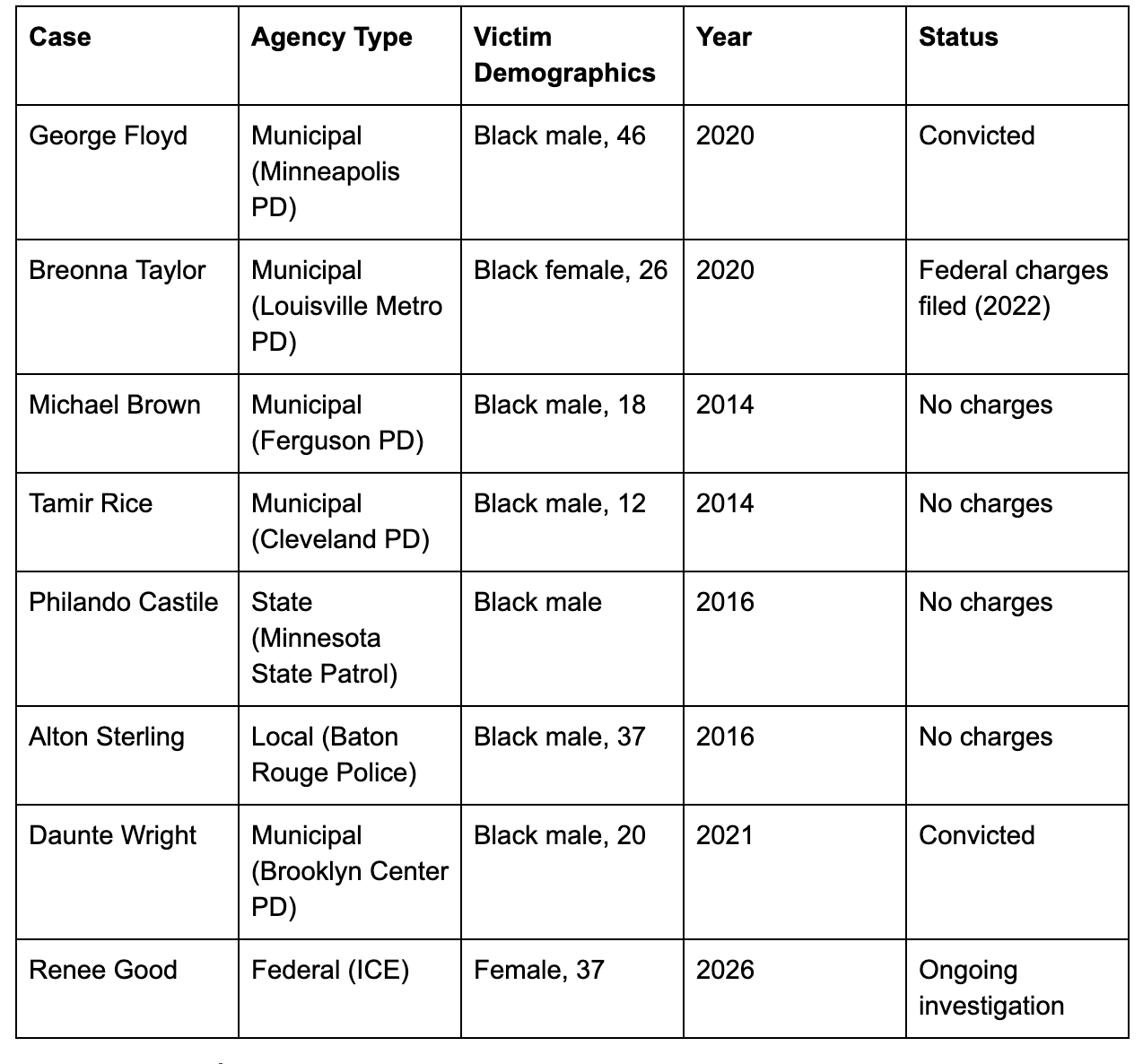
Data Sources
Police reports, medical examiner statements, court filings, Department of Justice notices, media coverage databases, protest documentation, institutional response records, and timeline analysis from contemporaneous reporting.
III. Observable Patterns: Media Amplification
Coverage Baseline and Racial Disparities
The research reveals dramatic variance in media attention following police-caused deaths. Baseline national data establishes that 82 percent of police killings receive zero coverage in local newspapers[1], while only 18 percent receive any local news mention. Among cases receiving coverage, the median publication count is 2 articles, with maximum coverage reaching 28 articles. This baseline establishes the exceptional nature of “high-profile” cases.
Within cases that do receive coverage, racial disparities are pronounced. Unarmed Black victims generate approximately 11 times the average number of news articles compared to unarmed white victims; by median calculation, Black victims receive 21 times more articles[2]. Black victims are four times more likely to appear in the New York Times and five times more likely to be mentioned on cable news networks (MSNBC, CNN, Fox)[2].
However, despite these disparities for high-profile cases, Black victims represent approximately 25 percent of police killings nationally. This creates a systematic misperception: public estimates of the Black victim share of police killings average 48 percent, suggesting that the high-profile cases that do receive extensive coverage create disproportionate visibility[3].
Timing and Persistence of Coverage
The George Floyd case demonstrates the scale of possible media amplification. Coverage peaked on June 6, 2020—12 days after Floyd’s death—with approximately 500,000 people in nearly 550 locations participating in protests on a single day[6]. National data documenting 7,750+ Black Lives Matter-related demonstrations between May 26 and August 22, 2020, indicates geographic dispersal across all 50 states and DC. Black media outlets showed particular responsiveness: on June 14, 2020, 68 percent of Black media stories covered racism-related topics, compared to 34 percent maximum in mainstream media[7].
Contrast this with the Breonna Taylor case, which occurred on March 13, 2020—two months before Floyd’s death. Black media reached peak coverage of Taylor on June 14, 2020, dedicating 16 percent of stories to her case, while mainstream media did not peak until September 24, 2020 (three months later), with only 5 percent of stories[7]. Notably, Black media devoted six times more coverage to Taylor than mainstream media devoted to George Floyd, despite Floyd’s murder generating greater overall coverage.
Media coverage framing varies systematically. The Renee Good ICE shooting case (January 2026) demonstrates immediate partisan differentiation: within 24 hours, Fox News characterized the incident as a defensive police action and “domestic terrorism,” while traditional and progressive media outlets framed it as a potential unjustified shooting[8]. Fox News aired federal administration statements 17+ times during initial coverage, while video analysis contradicted official narratives.
Headline Framing and Narrative Control
In the Michael Brown case, police released surveillance footage showing Brown at a convenience store, which major news outlets incorporated into coverage narratives. This framing—inserting the prior alleged robbery into the shooting narrative—was characterized by journalists as police-generated narrative control that complicated public understanding of the shooting itself[9].
Media coverage of police shootings consistently demonstrates early reliance on police statements. Researchers note that video evidence providing “audio-visual impact” carries far greater public persuasiveness than verbal recitation alone. However, the availability of video evidence does not guarantee immediate narrative correction; in several cases (Philando Castile, Alton Sterling, Renee Good), contradictions between official statements and video evidence emerged only after initial reporting cycles had established police-generated narratives[10].
IV. Observable Patterns: Public Mobilization
Scale and Speed of Protest Organization
The George Floyd uprising represents the largest measured mobilization in recent U.S. history by some quantifications. Polling data suggest 15 to 26 million Americans participated in Floyd-related demonstrations over multi-week periods, with conservative estimates of 2.7 million direct participants across nearly 12,000 documented events[11][12]. Peak protest activity occurred within two weeks of Floyd’s death.
In contrast, the Michael Brown case (August 2014) generated immediate local and national attention, with protests beginning August 10, 2014 (one day after the shooting). However, the protest wave was accompanied by state-level government intervention: the Missouri State Highway Patrol assumed control of security on August 14, and the National Guard was deployed August 18-21, 2014[13].
The Philando Castile (July 6, 2016) and Alton Sterling (July 5, 2016) cases demonstrate the impact of temporal proximity and concurrent media cycles. Castile’s shooting, which was live-streamed by his fiancée, generated immediate nationwide protest mobilization within hours. However, his case quickly overshadowed Sterling’s death in the media cycle despite Sterling’s death occurring first. Both cases collectively triggered what research identifies as the second major spike in antiracism protest attention since 2014[14][15].
Geographic Dispersion
The Floyd uprising achieved geographic reach unmatched by other recent cases. Demonstrations occurred in nearly every major city and dispersed to 2,440+ locations[16]. In contrast, the Michael Brown protests, though significant, showed more concentrated geographic distribution, with sustained presence in St. Louis and Ferguson, while other cities held time-limited solidarity demonstrations.
The Daunte Wright shooting (April 2021) occurred while the Derek Chauvin trial (the most high-profile police prosecution in decades) was ongoing in the same city. This temporal overlap appeared to limit protest scale compared to the Floyd uprising, as media and public attention remained divided.
The Renee Good ICE shooting (January 2026) generated immediate hundreds-scale protests in Minneapolis and geographic dispersal to other cities within 24-48 hours. However, this federal agency case involved jurisdictional opacity that local cases did not: federal authorities claimed exclusive investigative authority, blocking Minnesota state police from evidence access and interviews[17][18].
Protest Characteristics and Long-Term Sustainability
Research on high-profile police killings from 2014-2016 documents that such incidents trigger measurable de-policing effects—officers reduce self-initiated activities and arrest rates decline—suggesting protest impact on police behavior regardless of prosecution outcomes[19][20]. The Floyd uprising produced the most sustained mobilization, with daily or weekly marches in many cities continuing for months after the initial June 6 peak.
V. Observable Patterns: Institutional Response
Criminal Charges and Prosecution
Rarity of Criminal Charges: Only a fraction of police-involved deaths result in criminal charges. Research analyzing cases from 2005-2024 documents 204 officers charged with murder or manslaughter; only 64 were convicted (31 percent)[21][22]. Comparing across decades, the number of officers charged annually went from single digits (pre-2014) to low double digits (post-2014), representing a modest increase that researchers note is statistically insignificant relative to the ~1,000 police killings annually.
Case-Specific Outcomes:
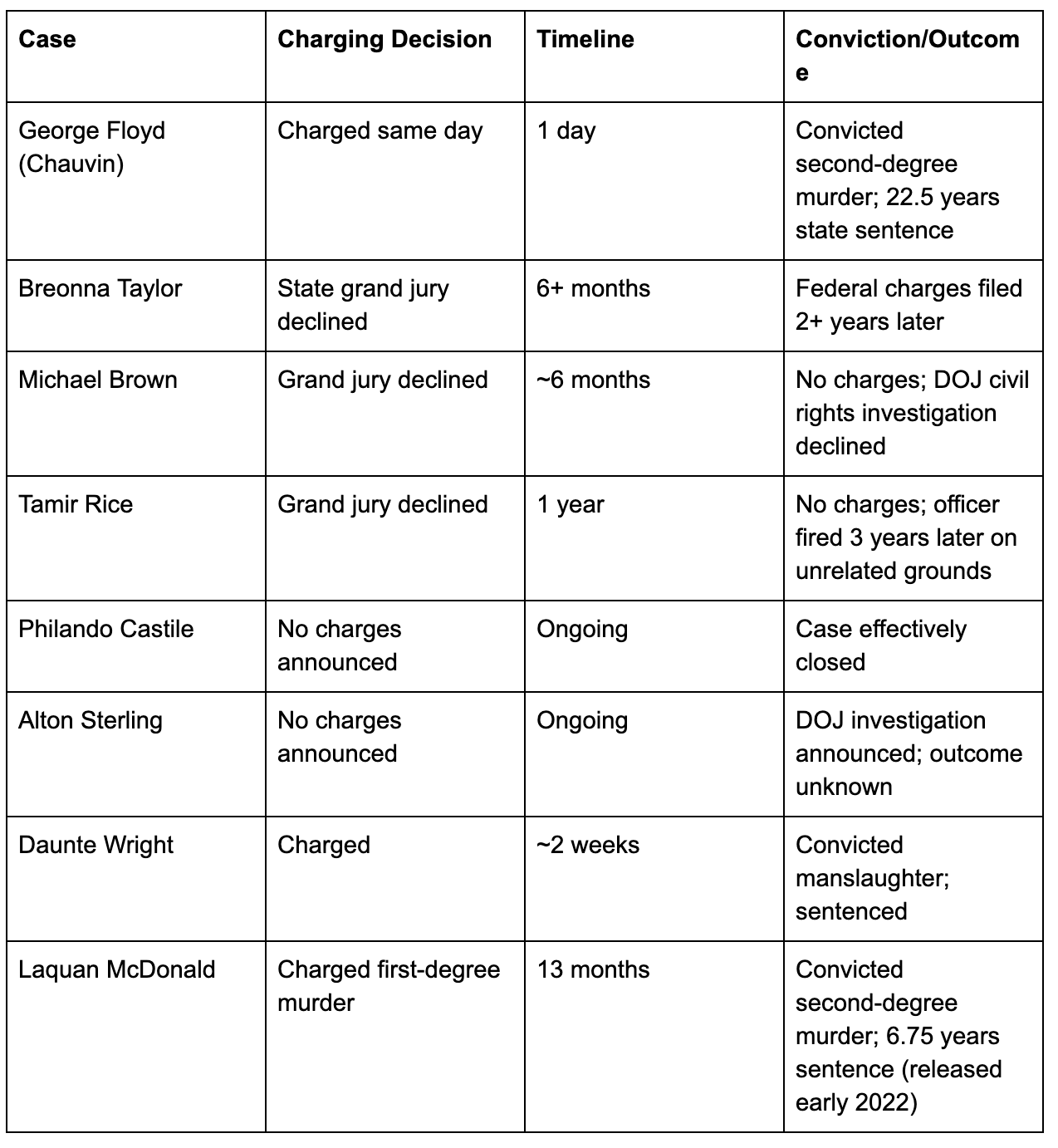
Time from Incident to Conviction: The Chauvin case proceeded remarkably quickly—361 days from death to guilty verdict on April 20, 2021[23]. The Laquan McDonald case required 1,414 days (nearly 4 years) from incident (October 13, 2014) to guilty plea (January 18, 2019)[24][25]. Typical felony case processing averaged 70-260 days pre-pandemic, with COVID-era increases adding an average 107 additional days across jurisdictions.
Conviction Rate Patterns: Officers convicted at roughly the same rate before and after 2014 (~50 percent of those charged), despite increased public attention and video evidence availability. Criminologist Philip Stinson notes that the increased availability of video evidence cuts both ways: while some videos support prosecution, many are used to defend officers, with prosecutors declining to charge in numerous cases with video documentation[26].
Charges Versus Administrative Discipline
In several cases, administrative discipline occurred absent criminal charges. Tamir Rice’s officer Timothy Loehmann was fired in May 2017—three years after the shooting—but not for the shooting itself; he was terminated for falsifying his employment application by omitting prior disciplinary history from another department. His partner Frank Garmback received a 10-day suspension for tactical violations (approaching the victim too closely), not for the shooting response[27].
In the Darryl Tyree Williams case (Raleigh, North Carolina), six officers were placed on paid administrative leave following his death from Taser misuse, but the District Attorney declined prosecution, ruling the officers’ actions “lawful.” Williams was subjected to three Taser deployments despite having a heart condition—a known risk factor for sudden cardiac death. His case exemplifies the pattern where administrative discipline substitutes for criminal accountability[28].
Federal Versus Local Agency Investigation Patterns
Federal agency cases demonstrate a distinct institutional response pattern. The Renee Good ICE shooting (January 7, 2026) resulted in FBI assumption of exclusive investigative authority, which prevented Minnesota state police (BCA) from accessing evidence, interview transcripts, or case materials. Minnesota Attorney General Keith Ellison disputed federal claims of “absolute immunity,” asserting that states retain constitutional authority to investigate and prosecute federal agents under limited circumstances. However, the practical effect was to place federal self-investigation as the sole official investigative entity[29].
This contrasts sharply with municipal cases, where state and local oversight mechanisms operate. Even in the George Floyd case, federal civil rights charges were filed against all four officers, creating parallel investigation tracks; the state convicted Chauvin, and federal charges subsequently resulted in guilty pleas/convictions for all four officers[30].
Media and Narrative Control
The Breonna Taylor case demonstrates how institutional framing precedes accountability mechanisms. The Louisville Metro Police Department’s initial statements characterized the raid as justified, and the Kentucky Attorney General’s grand jury decision (announced September 23, 2020) declined to charge any officer for Taylor’s death, charging only one officer (Brett Hankison) with wanton endangerment for shots fired into adjoining apartments. Federal charges were not filed until August 2022—over two years after the shooting[31][32][33]. During this extended gap, state-level institutional responses occurred: the police chief resigned, and the Louisville Metro Council voted unanimously to ban no-knock warrants (Breonna’s Law).
VI. Observable Patterns: Systemic Non-Response
Cases Without Charges or Prosecution
The Michael Brown, Tamir Rice, Philando Castile, and Alton Sterling cases all resulted in grand juries declining to indict officers. In each case, the standard narrative justification involved perceived threats or suspect behavior, framed through police reports filed contemporaneously with or immediately after incidents.
In Michael Brown’s case, the Ferguson police released surveillance footage allegedly showing Brown stealing merchandise, and Officer Darren Wilson was not identified by name until August 15, 2014 (six days after the shooting). The grand jury’s decision not to indict became public on November 24, 2014 (107 days after the shooting), triggering renewed national protests[34].
The Tamir Rice case involved a 12-year-old with a pellet gun. Officers responded to a 911 call reporting a “guy with a pistol,” though the caller stated the gun was “probably fake”—information not communicated to responding officers. A grand jury declined to indict in 2015, citing unclear video quality. Only through internal police investigation (completed in 2017) did discipline occur, and then on employment falsification grounds rather than the shooting itself[35].
Limited Accountability for Non-Lethal Force Deaths
The Associated Press investigation documented over 1,000 deaths from non-gunshot police force between 2013 and 2024[36]. In approximately 740 cases (71 percent), officers restrained victims in a prone position; in about 50 percent of those cases, officers violated safety guidelines by not rolling victims onto their sides after handcuffing[36].
In 538 Taser-involved deaths, 180 cases (33 percent) involved officers deploying Tasers more than three times or for more than 15 seconds combined, exceeding manufacturer and law enforcement organization guidance despite documented risks[37]. Taser manufacturer Axon and law enforcement organizations warned for over a decade that elderly individuals and those in mental health or medical crises face elevated sudden death risk from electrical shocks, yet officer training and accountability measures remain uneven.
The Darryl Tyree Williams case exemplifies institutional response to Taser deaths: despite excessive use in violation of guidelines and death following cardiac compromise, the District Attorney declined prosecution. No criminal charges resulted; administrative discipline (paid leave) was the maximum institutional response[38].
Sheriff’s Office Accountability Gaps
County sheriffs demonstrate substantially elevated lethal force rates coupled with minimal accountability. CBS News investigation found sheriffs 3 times more lethal than city police per 100,000 arrests (27 deaths versus 10 deaths), with a 100 percent increase in fatal encounters over the past decade[39]. Yet sheriffs face less public and media scrutiny than municipal police departments, despite these mortality rates.
Institutional accountability mechanisms prove particularly weak for elected sheriffs. The McCurtain County, Oklahoma sheriff was recorded discussing potential murder and burial of journalists who reported on departmental corruption; despite viral media scandal and gubernatorial calls for resignation, the sheriff remained in office. This case exemplifies how independent elected official status creates accountability gaps absent in municipal structures[40].
Reporting compliance undermines data-driven reform: 70 percent of states failed to meet federal use-of-force reporting requirements in fiscal year 2021, and the FBI’s use-of-force database received voluntary submissions from only 5,030 of 18,514 agencies (27 percent)[41].
VII. Policy and Systemic Reform Outcomes
Legislative Responses to High-Profile Cases
The George Floyd death catalyzed the most extensive state-level reform wave documented. At least 30 states and Washington, DC enacted statewide policing reforms by 2021, with 25 states addressing use of force, duty to intervene, or decertification[42].
Use of Force Reform: Many states clarified that deadly force is justifiable only as last resort after exhausting non-lethal alternatives. New state laws require law enforcement agencies to report use-of-force incidents to state or federal government[43].
Duty to Intervene: Twelve states and DC created legal duties for officers to intervene during excessive or illegal force, with penalties ranging from discretionary decertification to criminal liability. Eight states created duties to render medical aid for individuals under officer custody[44].
Decertification and Misconduct Reporting: Fourteen states enacted or strengthened law enforcement decertification processes; 13 states added requirements for misconduct reporting to the state[45]. Prior to 2020, only states like Massachusetts and Hawaii lacked centralized decertification authority; post-2020 reforms addressed this.
Implementation Constraints: Despite legislative changes, implementation faces obstacles. Many police departments already maintained duty to intervene policies at the time of Floyd’s death (Minneapolis included such a policy). Police union resistance and negotiated contracts continue to undermine policy implementation in numerous jurisdictions[46].
Breonna’s Law and Louisville-Specific Reform
The Taylor case generated immediate and sustained policy reform in Louisville despite the absence of criminal charges. Three months after Taylor’s death, the Louisville Metro Council unanimously voted to ban no-knock warrants (naming the ordinance Breonna’s Law). The ordinance also mandated body camera activation during search warrant execution—cameras that were not in use during the Taylor raid[48].
In February 2024, Louisville Metro and the DOJ began negotiating a federal consent decree, which was finalized in 2024. The agreement included existing city work: a 911 deflection program routing mental health crisis calls to non-police responders, a system for identifying problem officers, and enhanced de-escalation training. This case demonstrates how media attention and sustained protest activity can produce policy changes even during extended periods when criminal accountability remains unavailable[49].
Geographic and State-Level Variation
State attorneys general increasingly assume investigation and prosecution authority previously held exclusively by federal authorities. Colorado, following the Elijah McClain death (2019), launched state-level investigation revealing “pattern and practice of racially biased policing, excessive force, and inadequate documentation.” Illinois and California similarly activated state-level investigative authority post-2020[50].
Different states employ different models: some grant original jurisdiction to state attorneys general; others require request from local prosecutors; still others maintain purely concurrent or advisory powers. This variation creates inconsistent accountability mechanisms across state lines, with some jurisdictions (Nebraska, Connecticut, Maine) mandating special prosecutors for in-custody deaths, while others leave such decisions discretionary[51].
VIII. Competing Explanatory Factors (Non-Conclusive)
Media Cycle Saturation
The concurrent occurrence of Philando Castile and Alton Sterling deaths (July 5-6, 2016) demonstrates how temporal proximity affects sustained media coverage. Though Castile’s case received initially heavy coverage through live-stream video, Sterling’s death was quickly superseded in the news cycle, resulting in less sustained national attention despite comparable circumstances[52].
Victim Demographic Alignment with Activist Leadership
Research on the Black Lives Matter movement identifies cases where protest leadership and victim demographics diverged—white activists organizing around Black victims’ deaths, and vice versa. The #SayHerName framework emerged specifically to address erasure of Black women’s deaths (like Taylor’s) despite the movement’s broader visibility[53]. This suggests that demographic misalignment between victim and activist organizational infrastructure can delay or limit media amplification and sustained mobilization.
Geographic Proximity to Population Centers and Media Infrastructure
The Floyd uprising occurred in Minneapolis, a major metropolitan area with significant media presence; the uprising achieved national instantaneous attention. In contrast, the Alton Sterling case occurred in Baton Rouge, Louisiana—a smaller media market. While both cases received national coverage, the disparity in sustained coverage reflects partly population density and media resource concentration[54].
Federal Jurisdiction Effects
Federal agency involvement (ICE in the Renee Good case, FBI investigation authority in federal cases) produces distinct accountability patterns. Federal jurisdiction claims explicitly exclude state and local investigation access, creating single-entity investigations of federal agents by federal authorities. This structural dynamic differs fundamentally from municipal cases where state and local oversight can operate in parallel[55].
Historical Precedent and Precedent Awareness
The Tamir Rice case occurred during a period (2014-2015) when multiple high-profile police killings occurred within months of each other (Michael Brown August 2014, Eric Garner July 2014, Tamir Rice November 2014, Freddie Gray April 2015). This clustering of cases produced a first major spike in national attention to police killings. Subsequent cases (Castile, Sterling in 2016) triggered a second major wave. The Floyd case (May 2020) produced the largest documented spike. The precedent of prior cases and established protest infrastructure appeared to influence mobilization speed in subsequent incidents[56].
IX. Data Gaps and System Limitations
Incomplete National Data Collection
The federal government does not mandate or comprehensively compile police use-of-force data. The FBI maintains voluntary reporting systems that capture only ~27 percent of agencies’ data[57][58]. The CDC’s mortality data misses police-involved deaths due to language-reading software that fails to identify police involvement when death certificates lack specific terminology.
Official data report police homicides as 8 percent of all homicides (2012-2016); independent databases (Fatal Encounters) suggest substantially higher rates. This data gap undermines evidence-based reform and prevents systematic analysis of patterns[59].
Prosecution Data Limitations
While research documents 204 officers charged with murder/manslaughter (2005-2024), many ongoing cases lack final disposition data. The Renee Good case (January 2026) remains under FBI investigation with no charging decision announced. Ongoing cases introduce incomplete information into analyses.
Media Documentation Variability
Detailed protest attendance estimates are available for limited high-profile cases (Floyd uprising: detailed crowd counting; others: estimated ranges). Protest documentation varies by local reporting capacity, with major metropolitan areas producing more detailed records than smaller communities.
Victim Representation in Data
Cases involving non-shooting deaths (restraint, Taser, vehicle impact) receive less systematic documentation than shooting deaths. The AP’s investigation identified over 1,000 such deaths, but comprehensive historical database coverage remains incomplete compared to shooting incidents.
X. System Unpredictability: Unanswered Questions
The audit reveals significant unpredictability in institutional response and public mobilization patterns:
What factors most strongly correlate with sustained national media attention? Video evidence significantly increases coverage, but video presence does not guarantee sustained attention (as demonstrated by cases where video contradicted official narratives yet received initial police-framing coverage). Victim demographics matter, but Black female victims (Taylor) received delayed mainstream coverage despite six times higher Black media attention. Geographic location influences coverage, but the mechanism remains partly unexplained.
Does institutional response speed influence protest duration? Cases with rapid prosecution (Floyd: 361 days to conviction; Wright: ~8 months to trial) did not necessarily produce longer protest waves than cases with no charges (Brown, Rice, Castile, Sterling). The Floyd case produced the most sustained mobilization, but this may reflect pandemic conditions, timing relative to the 2020 election, and cumulative protest history rather than prosecution progression.
How do agency type and jurisdiction alter accountability pathways? Federal agencies (ICE) claim exclusive investigative authority that blocks state/local oversight; municipal agencies operate within state oversight structures; sheriffs face minimal external accountability despite elevated lethality. These structural differences produce fundamentally different accountability possibilities, but individual case outcomes within each category remain variable.
Why do similar incidents produce divergent response scales? The Philando Castile and Alton Sterling shootings—occurring within days, both video-documented, both involving Black male victims—produced different coverage persistence and protest scales. The Tamir Rice case (12-year-old with pellet gun) and the Renee Good case (37-year-old driver during ICE enforcement) involved radically different victim profiles and agency contexts, yet both experienced limited sustained national attention relative to the Floyd case.
XI. Conclusion: Audit-Style Assessment
This audit documents profound variance in institutional and public responses to law-enforcement-caused deaths. Observable patterns indicate:
Media amplification is inconsistent and demographic-influenced. While Black victims of police violence receive disproportionate coverage within the subset of cases that receive coverage at all, 82 percent of police killings receive no media attention whatsoever[1]. Media outlet framing varies systematically by partisan outlet (Fox News, MSNBC/CNN), with early reliance on police narratives that subsequent video evidence may contradict.
Criminal accountability is exceptionally rare. Of approximately 1,000 police killings annually, fewer than 1 percent result in criminal charges, and approximately 31 percent of those charged are convicted[21][22]. This rate has not substantially increased despite post-2014 reforms and increased public attention. Time from incident to resolution varies dramatically (361 days to 4+ years), with high-profile cases processed faster than typical felony cases but still requiring months to years.
Public mobilization is rapid but unpredictably sustained. The Floyd uprising achieved historic scale and geographic dispersal; other cases generated time-limited mobilizations. Protest speed appears disconnected from prosecution progress—cases with rapid convictions did not necessarily sustain longer protest activity than cases with no charges.
Institutional reforms occur through multiple pathways. Criminal conviction (Floyd), federal charges filed post-decline (Taylor), and policy pressure absent charges (Breonna’s Law) all produced institutional change, but implementation remains uneven. Police union resistance, existing policies that were not enforced, and minimal federal oversight (27 percent data compliance) limit reform effectiveness[41].
System accountability gaps are structural. Federal jurisdiction claims exclude state investigation; sheriff’s offices operate with minimal accountability despite elevated lethality; non-shooting force deaths receive less accountability attention than shootings; and national data incompleteness prevents evidence-based systemic reform[57][58][59].
The system demonstrates neither consistent escalation toward accountability nor consistent impunity—rather, profound unpredictability in outcomes that cannot be reliably predicted from incident characteristics, victim demographics alone, media coverage patterns, or initial institutional response speed.
From a systems perspective, the absence of predictable accountability pathways following law-enforcement-caused deaths constitutes an operational risk to public trust, legal consistency, and institutional legitimacy.
Sources Cited
[2] https://www.ojp.gov/pdffiles1/Digitization/155434NCJRS.pdf
[4] https://www.usccr.gov/files/2024-09/civil-rights-implications-of-frt_0.pdf
[5] https://civilrights.org/wp-content/uploads/Policing_Full_Report.pdf
[6] https://www.nytimes.com/interactive/2020/07/03/us/george-floyd-protests-crowd-size.html
[7] https://blackmediareport.journalism.cuny.edu/leading-the-way/
[9] https://pmc.ncbi.nlm.nih.gov/articles/PMC10993425/
[10] https://policebrutalitycenter.org/police-brutality/high-profile-killings/
[11] https://www.pnas.org/doi/10.1073/pnas.2117320119
[12] https://countingcrowds.org/2021/02/15/contours-of-the-george-floyd-uprising/
[13] https://digitalcommons.liberty.edu/cgi/viewcontent.cgi?article=6913&context=doctoral
[15] https://www.statista.com/statistics/1362796/number-people-killed-police-us/
[16] https://acleddata.com/report/demonstrations-and-political-violence-america-new-data-summer-2020
[17] https://www.nytimes.com/2025/05/24/us/police-killings-george-floyd.html
[18] https://www.sfdistrictattorney.org/wp-content/uploads/2020/08/BRP_report.pdf
[19]
https://mappingpoliceviolence.org
[20] https://www.statista.com/statistics/585152/people-shot-to-death-by-us-police-by-race/
[21] https://commons.emich.edu/cgi/viewcontent.cgi?article=1172&context=mcnair
[24] https://abc30.com/post/jason-van-dyke-trial-laquan-mcdonald-shooting-timeline/4147086/
[25] https://en.wikipedia.org/wiki/Murder_of_Laquan_McDonald
[27] https://www.cnn.com/2017/05/30/us/cleveland-tamir-rice-police-officers-disciplined
[28] https://www.pbs.org/newshour/show/police-face-new-scrutiny-for-use-of-tasers-after-deadly-incidents
[29] https://www.democracynow.org/2026/1/9/minnesota_attorney_general_keith_ellison
[30] https://www.brookings.edu/articles/breonna-taylor-police-brutality-and-the-importance-of-sayhername/
[31] https://michaelodbrown.org/timeline-of-events-in-shooting-of-michael-brown-in-ferguson/
[32] https://www.pbs.org/newshour/nation/breonna-taylor-supporters-relieved-by-charges-against-police
[34] https://pmc.ncbi.nlm.nih.gov/articles/PMC10993425/
[35] https://www.cnn.com/2016/07/07/us/philando-castile-alton-sterling-reaction
[37] https://www.pbs.org/newshour/show/police-face-new-scrutiny-for-use-of-tasers-after-deadly-incidents
[39] https://www.cbsnews.com/news/county-sheriffs-deaths-accountability/
[41] https://pmc.ncbi.nlm.nih.gov/articles/PMC6085013/
[42] https://www.brennancenter.org/our-work/research-reports/state-policing-reforms-george-floyds-murder
[43] https://apnews.com/article/michael-brown-timeline-ferguson-410824a723f91caeddce01e13860ce30
[45] https://jlsp.law.columbia.edu/wp-content/blogs.dir/213/files/2017/10/50-LARA.pdf
[47]
https://mappingpoliceviolence.org
[48] https://www.pbs.org/newshour/nation/cleveland-officers-tamir-rice-shooting-face-disciplinary-charges
[50] https://www.cnn.com/2021/09/25/us/state-attorneys-general-police-reform
[52] https://www.statista.com/statistics/1362796/number-people-killed-police-us/
[53] https://www.brookings.edu/articles/breonna-taylor-police-brutality-and-the-importance-of-sayhername/
[54] https://www.statista.com/statistics/1362796/number-people-killed-police-us/
[55] https://www.sfdistrictattorney.org/wp-content/uploads/2020/08/BRP_report.pdf
[59]
https://policeviolencereport.org