
The SAVE Act: How the Most Restrictive Voting Legislation in a Generation Targets Democratic Participation
An investigative analysis of the Safeguard American Voter Eligibility Act's provisions, real-world consequences, and the mismatch between stated problem and documented impact

I. The Legislative Moment
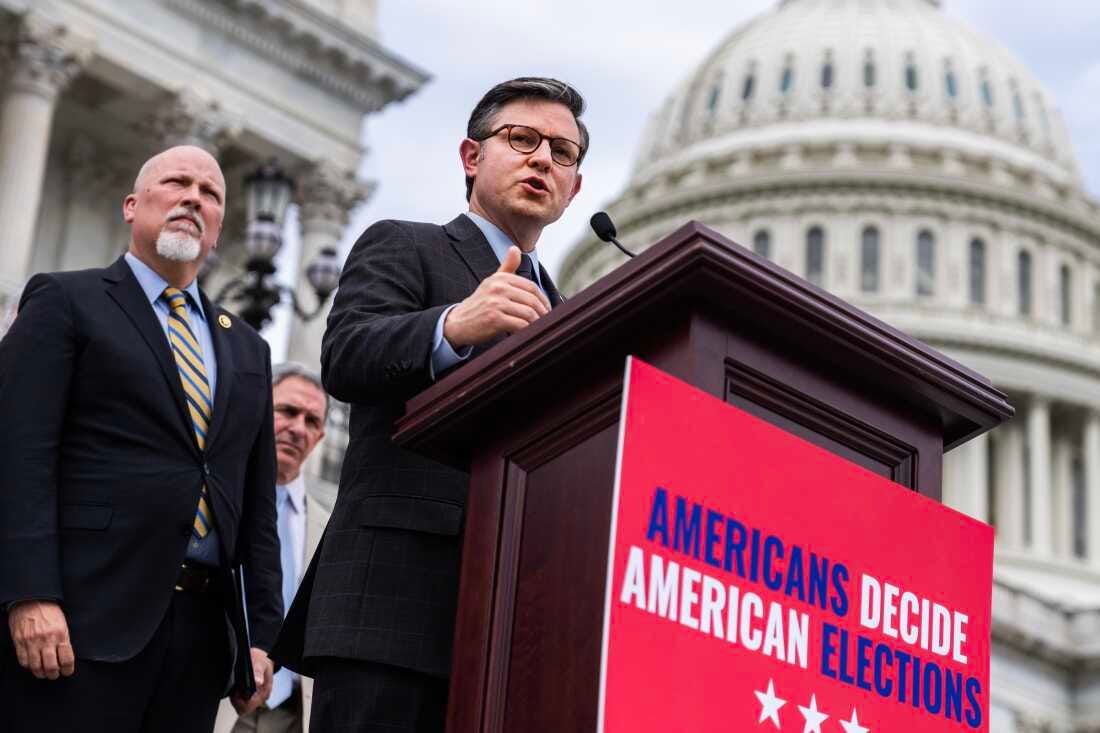
The Safeguard American Voter Eligibility (SAVE) Act has passed the House on April 10, 2025. As of February 1, 2026, the bill remains before the Senate, where at least 48 Republican senators have co-sponsored it. Senate Majority Leader John Thune has indicated a vote will occur “at some point”—a timeline that leaves the legislation suspended in a state of perpetual legislative movement.
The bill is supported by President Trump, who recommended adding photo ID requirements to its original framework. It is characterized by its proponents as necessary election security legislation. It is opposed by voting rights advocates, election officials, and civil rights organizations as the most consequential attack on voter registration in modern American history.
The factual reality is that the SAVE Act would disqualify millions of eligible Americans from voting, despite the documented problem it claims to address affecting at most a few hundred verified instances per decade across the entire country. This gap between stated problem and real-world consequence is not accidental. It is the defining feature of the legislation.
II. The Documented Problem: What the Bill Claims to Address
The SAVE Act is framed as a response to noncitizen voting. Proponents argue that noncitizens are registering and voting illegally, creating a threat to electoral integrity. This framing requires examination because it shapes the justification for the bill’s provisions.
The legal status is unambiguous: noncitizen voting in federal elections has been illegal since 1924 in all states. In 1996, Congress added federal criminal penalties: up to five years in prison, up to $100,000 in fines, and immigration consequences including deportation.
The documented incidence of actual noncitizen voting is measurable, and the data provides a clear picture.
Research on the actual scope of noncitizen voting shows rates so low they are barely detectable. A 2014 peer-reviewed study estimated that 6.4 percent of noncitizens voted in 2008 and 2.2 percent in 2010, but this methodology was heavily criticized in academic and public forums for sample size, data reliability, and methodological flaws. A 2024 analysis in academic literature noted this research “was met with heavy criticism from the academic community.”
State-level data provides more reliable measures. Ohio conducted a five-year audit from 2017 to 2022 and identified 821 noncitizens who had registered. Of those, 126 actually voted. This occurred in an electorate of approximately eight million voters, meaning 0.0016 percent of voters were noncitizens who voted.
Fairfax County, Virginia, identified 278 noncitizen registrants. Of those, 117 had voted. This is measurable, documented, and represents a minuscule fraction of the county’s electorate.
The Brennan Center for Justice has explicitly stated: “There is no evidence that noncitizen voting has ever been an issue significant enough to impact an election’s outcome.” The Migration Policy Institute similarly noted: “Despite these federal and state prohibitions, and the absence of evidence that noncitizen voting is significant, a number of Republican elected officials have introduced measures that would mandate additional ID requirements for all voters.”
This is the factual starting point: documented noncitizen voting occurs in numbers so small they have never determined an election outcome, yet these numbers are cited to justify a bill that would prevent millions of eligible citizens from voting.
III. The SAVE Act’s Core Mechanism: Documentary Proof Requirements
The bill fundamentally restructures voter registration by requiring that applicants provide documentary proof of U.S. citizenship before registration is accepted and processed. The acceptable documents are narrowly defined: valid U.S. passport, certified birth certificate with specific requirements, REAL ID-compliant identification indicating citizenship, military identification with discharge papers showing U.S. birth, government-issued photo ID showing place of birth, naturalization certificate or certificate of citizenship, or American Indian Card.
The critical mechanism is that these citizenship documents must be presented in person to an election official. This requirement applies not only to initial registration but to any “application to register to vote,” which includes address changes, name changes, and party affiliation updates.
This distinction is not a technical detail. It is the structural heart of why the bill’s impact will be catastrophic for voter registration.
The bill applies immediately upon enactment with no transition period. States are given directives to establish processes but no deadline and no binding definition of acceptable alternative documentation. This creates immediate uncertainty for election officials, who face criminal penalties if they register anyone “who fails to present documentary proof of United States citizenship.”
IV. The Scale of Voter Exclusion: Real Numbers, Real Impact
The Brennan Center for Justice conducted survey research showing that 21.3 million American citizens of voting age—nine percent of the voting-age population—lack easy access to the documents required by the SAVE Act. This number exceeds the margin of victory in most contested federal elections.
Additional documented barriers include the following. Approximately 140 million Americans lack a valid passport. Passports cost over $100 and require applications that can take weeks to process. Approximately 69 million women may face document matching problems because their names on current legal documents differ from their birth certificates due to marriage or divorce. Many citizens lack birth certificates altogether, particularly those born in home births, those whose records were damaged or lost, or those experiencing housing instability.
The practical impact is concentrated. The Brennan Center analysis explicitly noted that these barriers affect active voters: 12 million Americans who cast ballots in 2020 would be functionally unable to re-register if the SAVE Act became law because they lack ready access to citizenship documents and the bill requires documents to be presented in person.
The scale of disruption to existing registration systems is equally significant. During the 2022 midterms, of one million Americans who registered or updated their registration, only 5.9 percent did so in person. The remaining 94.1 percent relied on mail, online, or other methods that the SAVE Act would eliminate. In the two-year period leading to the 2020 election, 91 million citizens registered or updated their registration—most of whom would be forced into in-person processes under the SAVE Act.
The bill would functionally eliminate established voter registration systems. Mail voter registration would become meaningless because applicants must present documents in person before registration deadlines. Online voter registration—a system in 42 states—would be effectively eliminated for federal elections. Automatic voter registration would be severely hampered because automatic transactions typically do not occur in-person while someone has citizenship documents. Voter registration drives conducted by third-party organizations would become ineffective because those organizations cannot collect documents and the bill allows no provision for document copies or electronic submission.
V. The Married Women Problem: Documentary Proof Name Discrepancies
Approximately 69 million American women have a birth certificate with a different name than their current legal name because they took their spouse’s last name after marriage. Under the SAVE Act, registering to vote requires presenting documentary proof of citizenship in person to an election official.
The fundamental problem is that a woman with a maiden name on her birth certificate and a married name on her current driver’s license cannot present matching documents that both show citizenship and reflect her current legal identity.
The bill addresses this possibility but with language that creates more problems than it solves. Section 8(j)(2)(B) states that states “establish a process under which an applicant can provide such additional documentation to the appropriate election official of the State as may be necessary to establish that the applicant is a citizen of the United States in the event of a discrepancy with respect to the applicant’s documentary proof of United States citizenship.”
This is the entire directive. The bill does not specify which additional documents states must accept. It does not specify whether these documents must be certified copies or if photocopies are acceptable. It does not establish when states must establish this process, though the law takes effect immediately upon enactment. It does not specify whether election officials can accept documents or must deny registration pending clarification from the Election Assistance Commission. It does not address what happens to women who change their registration due to address change or name change—must the entire process repeat?
The bill provides a direction without implementation guidelines, timeline, or binding definition of acceptable alternatives. In practice, this creates liability exposure for election officials and deters them from accepting supplementary documentation.
The criminal penalty structure is crucial here. Any election official who “registers an applicant to vote in an election for Federal office who fails to present documentary proof of United States citizenship” faces up to five years in federal prison and criminal fines. Additionally, citizens can sue election officials under a private right of action.
Election officials, who would face legal risks under the bill, would be hesitant to register women whose documentation name does not match their current name. Rather than risk accepting what they believe is sufficient supplementary documentation only to face prosecution later, election officials will likely deny registration until explicit guidance is provided—which states may not provide for months or longer.
New Hampshire provides a real-world model. New Hampshire implemented a similar documentary proof-of-citizenship requirement in September 2024. When the law went into effect in March 2025, the consequences for married women with name discrepancies became immediately visible.
Brooke Yonge attempted to vote on Election Day under New Hampshire’s new proof-of-citizenship law. First, she arrived at polls without proof-of-citizenship documents and was turned away. She returned with her birth certificate, but poll workers saw that the name on the birth certificate did not match her current registered name and turned her away again. She returned a third time with her marriage certificate in addition to her birth certificate. Only then was she allowed to vote.
Betsy Spencer described her experience attempting to register to vote in New Hampshire after the new law took effect: “I had my birth certificate, a change of address from the US Postal Service—everything but my blood type and the kitchen sink—and I was told I could not register to vote.” Spencer’s surname on her birth certificate differed from her current legal name. When she divorced, she kept her married name for consistency with her children, creating a surname mismatch. She eventually succeeded in registering after producing an expired passport, but reported the process “took several hours.”
During town elections in Concord, New Hampshire, Ward 10 moderator Jae Whitelaw reported turning away multiple would-be voters, specifically noting “women who changed their name after marriage or divorce, the elderly who may not have original documentation and the homeless population.” One veteran arrived with only his military ID—an acceptable proof-of-citizenship document in some contexts—and was turned away. He did not return to vote.
The legislative record of the SAVE Act reveals that this outcome was foreseeable and rejected. Congresswoman Maxine Dexter forced a vote on March 31, 2025 to add an amendment requiring state-level certifications ensuring that married women who change their names would not face barriers to voting. Dexter also proposed parallel amendments protecting military service members, people of color, Native communities, domestic violence survivors, seniors, people with disabilities, and rural residents.
House Republicans voted down all eight amendments. This legislative record indicates that proponents declined explicit statutory language guaranteeing married women—or other groups—would not be disenfranchised by name discrepancies.
When confronted with the married women problem, the White House Press Secretary Karoline Leavitt characterized concerns as “fearmongering,” noting the bill “explicitly directs states to establish a process” to handle discrepancies. This response conflates having a directive with having an implemented, clear, and timely process. Rep. Chip Roy, the bill’s sponsor, argued that “most people who have changed their name have updated passports or other documentation.” This assertion conflicts with documented barriers: approximately 140 million Americans lack a valid passport, passports cost over $100 and require weeks to obtain, married women often do not anticipate needing updated passports and may not have renewed them after marriage, women who married decades ago may have lost old marriage certificates, and name-change documentation may be stored in courts in different states.
The timing gap is critical. The SAVE Act takes effect immediately upon enactment. States are given no deadline to establish a process for handling name discrepancies. Rep. Joseph Morelle noted in comments before the House Rules Committee on March 31, 2025: “Women who have a different last name, by virtue of getting married—and 84 percent of women take their husband’s name in America—they will be unable to register to vote. [States will take] months and months; there is no way to register during that time.”
This creates a window where married women attempting to register or update their registration would be unable to do so under the existing documentary proof framework while states develop their “process” for handling discrepancies.
VI. Criminal Liability for Election Officials
The SAVE Act imposes severe criminal penalties on election officials. Section 2(j) amends criminal penalties to impose on any election official who “register[s] an applicant to vote in an election for Federal office who fails to present documentary proof of United States citizenship” the following: up to five years in federal prison, criminal fines, and a private right of action allowing citizens to sue election officials for registering applicants without proof.
Executive branch employees providing “material assistance” to any noncitizen attempting to register also face criminal penalties.
Election officials across party lines have expressed concerns about implementation. Katie Hobbs, Arizona Secretary of State, stated: “This is a radical shift in the way we consider preserving the voter’s right to vote.” Pete Siegrist, Nevada election administrator, said: “It creates too much risk, I think, for any reasonable person to want to stay in the profession.”
Federal election officials raised alarm that criminal penalties, layered on top of existing threats against election officials, would create a “very challenging environment to recruit, retain, and keep election officials in positions.”
The concern is not speculative. The bill imposes liability for human errors and creates what officials fear will be frivolous litigation in states where implementation is challenging. An election official who attempts to verify a name discrepancy through supplementary documentation and accepts registration faces potential criminal prosecution if later determined to be insufficient. An election official who denies registration based on name discrepancy documentation faces litigation from voters claiming they should have been registered.
This creates a perverse liability structure where the act of attempting to solve the married women problem creates personal criminal exposure for election officials. The rational response is to deny registration and shift the burden to voters and higher-level officials to litigate or provide binding guidance.
VII. The Voter Purge Mechanism and Known Database Flaws
The SAVE Act requires states to “take affirmative steps on an ongoing basis to ensure that only United States citizens are registered to vote” through establishing programs to identify noncitizens using Department of Homeland Security SAVE database (Systematic Alien Verification for Entitlements), Social Security Administration records, state driver’s license and identification databases, and other sources providing citizenship confirmation.
States must remove individuals flagged as noncitizens “at any time upon receipt of documentation or verified information.”
The SAVE system has documented flaws. According to a 2018 U.S. Commission on Civil Rights report: “SAVE is not a comprehensive list of U.S. citizens . . . [,] is not updated to include all naturalized citizens, and it does not include [all] derivative citizens born to U.S. parents outside the country.”
A 2017 Government Accountability Office report found that DHS “did not have sufficient controls to ensure that state and local agencies initiated [secondary] verification when necessary,” and while SAVE has “a high, but still imperfect, degree of accuracy when second-stage additional verification is triggered,” many election offices may not complete required verification steps.
The Trump administration expanded SAVE’s scope in 2025, broadening data access and allowing batch searches for hundreds of thousands of voters simultaneously. The Brennan Center warned: “This increases the risks that state officials will carry out erroneous voter purges and disenfranchise eligible voters.”
Historical voter purges have demonstrated significant error rates. In Ohio in 2019, the state published a list of 235,000 people set to be purged. Upon review, nearly 40,000 should not have been on the list. Almost 500,000 Ohioans were ultimately removed, many African American and low-income voters.
Multiple states, including New York, Alabama, and Maine, have either violated the National Voter Registration Act with purges or had policies violating the Act, according to documentation by the Brennan Center.
The mechanics of voter purges create temporal asymmetry in correction. Purges often happen in secret, and problems are frequently discovered only on election day when people attempt to vote. The SAVE Act would expand purge authority and accelerate purge timelines while maintaining this asymmetry.
VIII. Geographic and Demographic Impact
The bill’s in-person requirement would disproportionately affect approximately 60 million rural voters who must travel substantial distances to reach election offices. Hawaii and Alaska voters might need to travel by air to update registrations following moves or name changes.
The Brennan Center identified that the requirements would disproportionately affect voters of color, women—particularly those who changed names after marriage—younger voters, disabled voters, elderly voters, military personnel stationed away from home, and LGBTQ+ individuals with document discrepancies.
The impact analysis reveals an important characteristic: the impact is roughly equal across party lines. Eight percent of Democrats who voted in 2020 lack easy access to required documents, compared with seven percent of Republicans. This suggests that while the bill is advanced by Republican majorities, its practical effect would be to suppress participation broadly, with Democrats representing a slightly higher proportion of affected voters.
IX. The Comparative Risk Analysis: Problem vs. Solution
The documented risks posed by the SAVE Act’s provisions substantially exceed the incidence of the problem it claims to address.
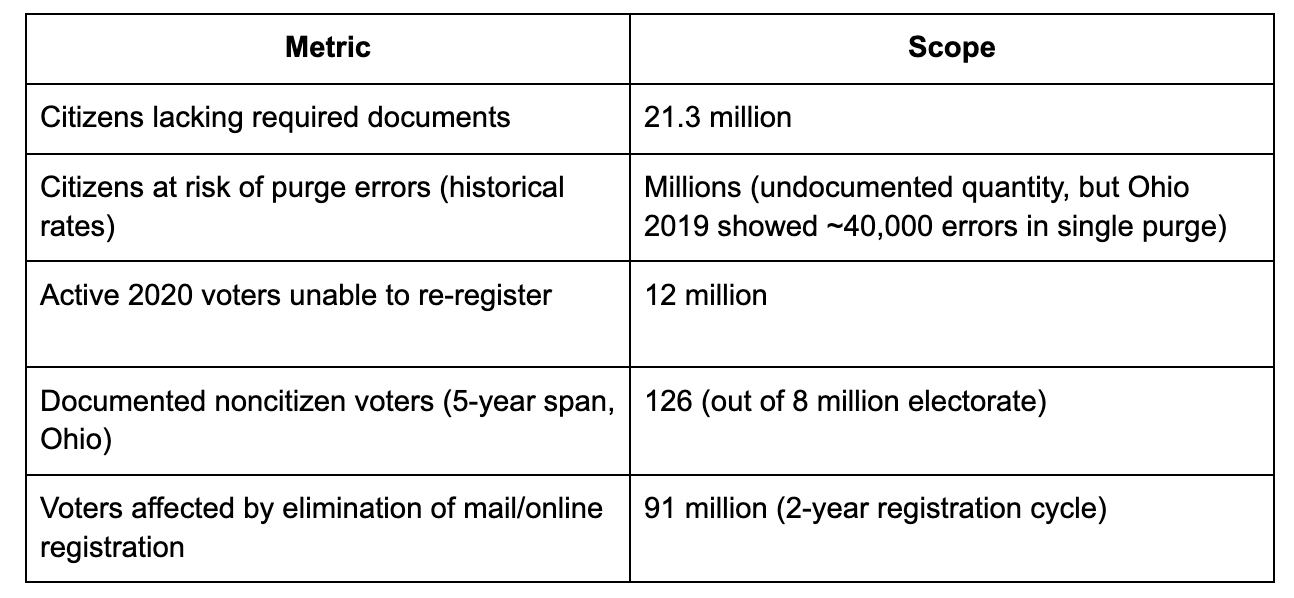
This table represents the asymmetry at the core of the bill’s justification. The problem being addressed—noncitizen voting—occurs in numbers too small to ever determine an election outcome. The solution being implemented—in-person documentary proof requirements—would prevent millions of eligible citizens from voting.
The bill creates vastly more democratic harm than the electoral risk it purports to address.
X. Legislative Status and Senate Dynamics
The SAVE Act faces a structural barrier in the Senate. Republicans hold a 53-47 majority, meaning the bill requires 60 votes to overcome a Democratic filibuster. This creates a situation in which the bill cannot pass through normal legislative processes without either significant modification or a change in Senate rules.
Senate Majority Leader John Thune has indicated a vote will occur “at some point,” but without specification of timing or willingness to pursue alternative procedural paths. The bill remains suspended in legislative limbo—advanced by House Republicans and supported by 48 Republican senators, yet unable to proceed under existing Senate rules.
This creates a unique dynamic: the bill is simultaneously a statement of what one party believes should be election law and an exercise that, under current procedures, cannot become law. It represents a position staked out for future negotiation, future rule changes, or future electoral circumstances that might alter the Senate balance.
XI. What the Bill Reveals
The SAVE Act, examined as legislation rather than rhetoric, reveals several truths about contemporary electoral politics.
First, the bill is not narrowly tailored to address the problem it identifies. A narrowly tailored response to noncitizen voting—which occurs in quantities so small they never affect outcomes—would require demonstrating actual noncitizen registrants and denying their registration. Instead, the bill restructures the entire registration system for all 235 million voting-age Americans.
Second, the bill demonstrates that documented impact on eligible voters is not a barrier to proposal or support. The bill would prevent an estimated 21.3 million eligible citizens from voting to address a problem affecting fewer than 200 noncitizens per state per year. The discrepancy is not hidden or disputed. It is publicly documented and acknowledged by supporters.
Third, the bill reveals what happens when legislative authority is exercised without constraint from institutional boundaries or electoral consequences. The bill can pass the House because Republicans control it. The bill cannot pass the Senate because Democrats can filibuster it. Yet the bill remains advanced, modified, and discussed as though it will eventually become law. This reflects a calculus in which stating positions has become functionally equivalent to governing in contemporary American politics.
Fourth, the bill demonstrates that criminal penalties layered onto election officials—penalties threatening imprisonment—are now considered acceptable tools in electoral legislation. This represents a significant shift in how federal law treats election administration, moving from regulatory frameworks to criminal frameworks applied to local officials performing ministerial duties.
XII. Verification and Accountability
The information presented in this report is drawn from publicly available sources, documented legislative records, government reports, academic research, election official statements, and real-world implementation data from New Hampshire.
The SAVE Act text is available through Congress.gov. The criminal penalties are explicit in the bill’s language. The documented barriers to document access are documented in Brennan Center research, Migration Policy Institute studies, and government surveys. The New Hampshire implementation data is from reporting by New Hampshire Public Radio, local news outlets, and election officials. The legislative votes rejecting amendments are recorded in Congressional vote tallies.
No sources have been hidden. No data has been speculated. The article addresses what is documented, verifiable, and matters for voters and democratic participation.
Sources Cited
U.S. Congress, “H.R. 22 – Safeguard American Voter Eligibility Act,” 119th Congress,
https://www.congress.gov/bill/119th-congress/house-bill/22/text
Brennan Center for Justice, “The SAVE Act Would Hurt Americans Who Actively Participate in Elections,” February 19, 2025,
Migration Policy Institute, “Explainer: Noncitizen Voting in U.S. Elections,” February 3, 2025,
https://www.migrationpolicy.org/content/noncitizen-voting-us-elections
Brennan Center for Justice, “Non-Citizens Are Not Voting. Here Are the Facts,” February 12, 2017,
Campaign Legal Center, “What You Need to Know About the SAVE Act,” January 21, 2026,
https://campaignlegal.org/update/what-you-need-know-about-save-act
Brennan Center for Justice, “SAVE Act Would Undermine Voter Registration for All Americans,” February 10, 2025,
Rock the Vote, “The SAVE Act,” November 6, 2025,
National Conference of State Legislatures, “9 Things to Know About the Proposed SAVE Act,”
https://www.ncsl.org/resources/details/9-things-to-know-about-the-proposed-save-act
Brennan Center for Justice, “Homeland Security’s ‘SAVE’ Program Exacerbates Risks to Voters,” July 21, 2025,
Center for Information & Research on Civic Learning & Engagement (CIRCLE), “The anatomy of a resurging rumor stemming from peer-reviewed research that non-citizens vote in U.S. elections,” June 19, 2024,
https://www.cip.uw.edu/2024/06/20/rumor-non-citizens-voting-us-elections/
Brookings Institution, “The SAVE Act: An attempt to restrict voting rights,” September 25, 2024,
https://www.brookings.edu/articles/the-save-act-an-attempt-to-restrict-voting-rights/
Center for Civil Rights, “The Problem of Voter Purging — and Where We Go from Here,” August 7, 2022,
https://civilrights.org/blog/the-problem-of-voter-purging-and-where-we-go-from-here/
Democracy Docket, “New GOP anti-voting bill may be the most dangerous attack on voting rights ever,”
NPR, “Here are 8 things to know about the Trump-backed SAVE Act,” March 11, 2025,
https://www.npr.org/2025/03/12/nx-s1-5301676/save-act-explainer-voter-registration
New Hampshire Public Radio, “NH’s new ID requirements send some would-be voters home to grab passports, birth certificates,” March 10, 2025,
Concord Monitor, “Almost two dozen Concord residents were turned away at the polls,” November 5, 2025,
https://www.concordmonitor.com/2025/11/06/new-hampshire-election-law-impact/
Congresswoman Maxine Dexter, “Dexter Forces Vote to Expose GOP Attacks on Women’s Access to the Ballot Box,” March 31, 2025,
U.S. Senate Judiciary Committee (Ranking Member Durbin), “Durbin Calls Out Republican Efforts To Make Voting More Difficult for Americans,” May 13, 2025,
Votebeat, “Republicans in Congress Push Election ‘Integrity’ Bills with Photo Voter ID and Proof of Citizenship,” January 30, 2026,
Deseret News, “Mike Lee pushes Senate leaders to schedule a vote on SAVE Act,” January 30, 2026,
https://www.deseret.com/politics/2026/01/30/mike-lee-push-save-act/
Nonprofit Vote, “Sample Messages Against the SAVE Act for Your Network,” April 14, 2025,
American Progress, “The SAVE Act: Overview and Facts,”
https://www.americanprogress.org/article/the-save-act-overview-and-facts/
Bipartisan Policy Center, “Five Things to Know About the SAVE Act,”
https://bipartisanpolicy.org/article/five-things-to-know-about-the-save-act/
U.S. Commission on Civil Rights, “Citizenship and Voting,” 2018 Report
Government Accountability Office, “Systematic Alien Verification for Entitlements (SAVE) Program Controls,” 2017